How
It Works: Mechanisms of Acupuncture |
Yes. In the past 4,500 years, more people have been successfully treated with acupuncture than with all other health modalities combined. Today acupuncture is practiced widely in Asia, the Soviet Union, and in Europe. It is now being used more and more in America. Acupuncture treatments
can be given at the same time that other techniques are being used,
such as conventional Western medicine, osteopathic or chiropractic
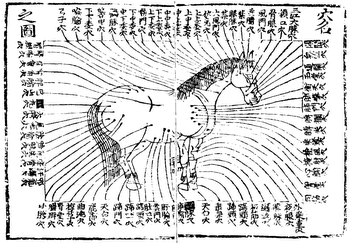
adjustments, and homeopathic or naturopathic prescriptions. No. Acupuncture has been used to successfully treat cats, dogs, horses and other animals in a number of well-documented veterinary acupuncture studies. These animal patients do not understand or believe in the process that helps them get better.
Illustration
of acupuncture points on the body of a horse from A positive attitude toward wellness may reinforce the effects of the treatment received, just as a negative attitude may hinder the effects of acupuncture or any other treatment. A neutral attitude ("I don't know if I really believe in this.") will not block the treatment results. One study (Moore & Berk 1976) assessed the effect of positive versus negative settings for acupuncture and found no difference. They also tested hypnotic suggestibility in terms of pain reduction, but again found no significant correlation with response to acupuncture treatment. Being more or less susceptible to hypnosis has no relation to one’s responsiveness to acupuncture treatment. HOW DOES ACUPUNCTURE
WORK? The classical Chinese explanation is that there are channels of energy (chi) that form regular patterns throughout the body. These energy channels, called “meridians,” are like rivers flowing through the body to irrigate and nourish the tissues. An obstruction in the movement of these energy rivers is like a dam that backs up the flow in one part of the body and restricts it in others. Needling or otherwise stimulating the acupuncture points can influence the meridians. The needles help unblock the obstructions and re-establish the regular flow through the meridians. By harmonizing the flow of energy in the meridians, acupuncture can help correct imbalances in many of the body’s systems, including the internal organs. The modern scientific
explanation is that needling the acupuncture points stimulates the
nervous system to release chemicals in the muscles, spinal cord,
and brain, including endorphins, enkephalins and other neurotransmitters.
These chemicals will either change the experience of pain, or they
will trigger the release of other chemicals and hormones which influence
the body's own internal regulating system, bringing about a normalizing
effect on neuroendocrine function. The improved energy and biochemical
balance produced by acupuncture results in stimulating the body's
natural healing abilities, and in promoting physical and emotional
well-being.
One of the studies cited by the NIH was conducted by Abass Alavi, M.D., chief of nuclear medicine at the University of Pennsylvania Medical Center, who showed that acupuncture affects the flow of blood in the brain. He used SPECT (single photon emission computed tomography) to view the brains of four people with pain and five pain-free people who served as the control group. Dr. Alavi found that after acupuncture needles were inserted, all of the patients had increased blood flow to the thalamus, the area of the brain that relays pain and other sensory messages. Because the brains of the pain-free group showed the same reactions as those with pain, the changes in blood flow couldn’t be attributed to placebo. 1. PET-Scans of the brain during acupuncture (Dold, 1998): University of California Irvine professor and physicist Zang-Hee Cho, a member of the highly respected National Academy of Science, the inventor of an early version of the Positron Emission Tomograph, or PET scan, and a pioneer of the MRI scanner, both of which have revolutionized our ability to see into the body and brain, found that stimulation of the vision-related acupoint showed the same reaction in the brain as stimulation of the eye. As the acupuncture signal passes to the brain via nerves, it possibly stimulates the hypothalamus, the “executive center” of the brain, responsible for the production and release of hundreds of neurochemicals, Cho said. 2. Acupuncture: pain management coupled to immune stimulation (Gollub, 1999): “The phenomenon of acupuncture is both complex and dynamic. Recent information demonstrates that acupuncture may exert its actions on pain and immune processes. The coupling of these two systems occurs via common signaling molecules, i.e., opioid peptides. In this regard, we surmise that
3. (Fu, 2000): “In recent years, more and more laboratory proof has accumulated that acupuncture can
4. Immune System effects of Acupuncture (Joos, 2002): “The following changes were found in the TCM group: within the lymphocyte subpopulations the CD3+ cells (p = 0.005) and CD4+ cells (p = 0.014) increased significantly. There were also significant changes in cytokine concentrations: interleukin (IL)-6 (p = 0.026) and IL-10 (p = 0.001) decreased whereas IL-8 (p= 0.050) rose significantly. Additionally, the in vitro lymphocyte proliferation rate increased significantly (p = 0.035) while the number of eosinophils decreased from 4.4% to 3.3% after acupuncture (p > 0.05). The control group, however, showed no significant changes apart from an increase in the CD4+ cells (p = 0.012).” 5. Difference
between Manual and Electro Acupuncture (Kong, 2002): “Results
showed that electroacupuncture mainly produced fMRI signal increases
in precentral gyrus, postcentral gyrus/inferior parietal lobule,
and putamen/insula; in contrast, manual needle manipulation produced
prominent decreases of fMRI signals in posterior cingulate, superior
temporal gyrus, putamen/insula. These results indicate that different
brain networks are involved during manual and electroacupuncture
stimulation. It suggests that different brain mechanisms may be
recruited during manual and electroacupuncture.”
|