Now, Let Me Tell You About My Appendectomy in Peking...
by James Reston
New York Times, Monday July 26, 1971
PEKING, July 25--There is something a little absurd about a man publishing an obituary notice on his own appendix, but for the last 10 days this correspondent has had a chance to a learn little about the professional and political direction of a major Chinese hospital from the inside, and this is a report on how I got there and what I found.
In brief summary, the facts are that with the assistance of 11 of the leading medial specialists in Peking, who were asked by Premier Chou En-lai to cooperate on the case, Prof. Wu Wei-jan of the Anti-Imperialist Hospital's surgical staff removed my appendix on July 17 after a normal injection of Xylocain and Bensocain, which anesthetized the middle of my body.
There were no complications, nausea or vomiting. I was conscious throughout, followed the instructions of Professor Wu as translated to me by Ma Yu-chen of the Chinese Foreign Ministry during the operation, and was back in my bedroom in the hospital in two and a half hours.
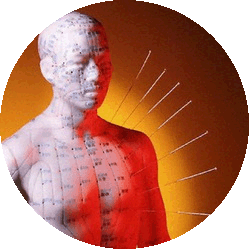
However, I was in considerable discomfort if not pain during the second night after the operation, and Li Chang-yuan, doctor of acupuncture at the hospital, with my approval, inserted three long thin needles into the outer part of my right elbow and below my knees and manipulated them in order to stimulate the intestine and relieve the pressure and distension of the stomach.
That sent ripples of pain racing through my limbs and, at least, had the effect of diverting my attention from the distress in my stomach. Meanwhile, Doctor Li lit two pieces of an herb called ai, which looked like the burning stumps of a broken cheap cigar, and held them close to my abdomen while occasionally twirling the needles into action.
All this took about 20 minutes, during which I remember thinking that it was a rather complicated way to get rid of gas in the stomach, but there was noticeable relaxation of the pressure and distension within an hour and no recurrence of the problem thereafter.
I will return to the theory and controversy over this needle and herbal medicine later. Meanwhile, a couple of disclaimers.
Judging from the cables reaching me here, recent reports and claims of remarkable cures of blindness, paralysis and mental disorders by acupuncture have apparently led to considerable speculation in America about great new medical breakthroughs in the field of traditional Chinese needle and herbal medicine. I do not know whether this speculation in justified, and am not qualified to judge.
Hardly a Journalistic Trick
On the other side, it has been suggested that maybe this whole accidental experiment of mine, or at least the acupuncture part of it, was a journalistic trick to learn something about needle anesthesia. This is not only untrue, but greatly overrates my gifts of imagination, courage and self-sacrifice. There are many things I will do for a good story, but getting slit open in the night or offering myself as an experimental porcupine is not among them.
Without a single shred of supporting medical evidence, I trace my attack of acute appendicitis to Henry A. Kissinger of the White House staff. He arrived in China on July 9. My wife and I arrived in South China the day before, just in time.
But when we reached Canton we were told by our official guide that there had been a change in our plans. We were to remain in the Canton area for two days and proceed by rail to Peking on the evening of the 10th arriving in the capital on the 12th. We debated and asked to fly to Peking at once, but we were told it was out of the question.
Three days later, at precisely 10:30 AM, while I was describing to several Foreign Ministry officials at the Peking International Club the unquestionable advantages of my interviewing Chairman Mao Tse-tung, Premier Chou and every other prominent official I could think of, Chen Chu, the head of the ministry's information service interrupted to say that he had "a little news item."
"Mr. Kissinger had been in Peking from July 9 to July 11." He said, and it was now being announced here and in the United States that President Nixon would visit Peking before May.
The First Stab of Pain
At that precise moment, or so it now seems, the first stab of pain when through my groin. By evening I had a temperature of 103 degrees and in my delirium I could see Mr. Kissinger floating across my bedroom ceiling grinning at me out of the corner of a hooded rickshaw.
The next day I checked into the Anti-Imperialist Hospital, a cluster of gray brick buildings with green-tiled roofs behind high walls of the middle of Peking.
The hospital had been established by the Rockefeller Foundation of New York in 1916 and supported by it, first as the Union Medical College of Peking and later as the Peking Union Medical College.
By coincidence I had had a letter before leaving New York from Dr. Oliver McCoy, president of the China Medical Board of New York explaining that his organization had been responsible for building and running the hospital with Rockefeller money until it was nationalized by the Communist Government in January, 1951. Dr. McCoy said that if we should happened to notice "a large group of buildings with green-tiled roofs not far from the southeast corner of the Forbidden City, it might be interesting to inquire what those were." It was interesting indeed.
My wife and I were taken to Building No. 5, which is the wing used to serve the Western diplomatic corps and their families. On the right of the entrance was a large sign quoting Chairman Mao (it was removed during our stay). "The time will not be far off" It said, "when all the aggressors and their running dogs of the world will be buried. There is certainly no escape for them."
We were taken at once by elevator to the third floor and installed in a suite of plain but comfortable rooms with large light-blue-bordered scrolls of Chairman Mao's poems on the walls and tall windows overlooking a garden filled with cedars. It was a blazing hot and humid evening, with the temperature at 95 degrees, but a revolving fan at least stirred the air. I stripped and went to bed.
Tests and a Checkup
A few minutes later the two doctors who had originally called on me at the Hsin Chiao Hotel came in and said they had arranged some tests. They were Prof. Li Pang-chi, a calm and kindly man who was the "responsible person" for the case, and Chu Yu, a visiting surgeon and lecturer at the Anti-Imperialist Hospital.
Professor Li, who understood and spoke a little English, explained that other doctors would examine me later and that there would be consultations about what was to be done.
A parade of nurses and technicians then slipped quietly into the room. They bathed me with warm towels. They checked everything I had that moved or ticked. The took blood out of the lobe of my ear. They took my temperature constantly, measure pulse and blood pressure and worried over a cardiogram showing a slightly irregular heartbeat. They were meticulous, calm and unfailingly gentle and cheerful.
An hour later the consultants summoned by Premier Chou arrived; surgeons, heart specialists, anesthetists, members of the hospital's revolutionary committee, or governing body. Each in turn listened to the offending heartbeat.
I felt like a beached white whale at a medical convention and was relieved when they finally retired for consultation and returned with the verdict; "Acute appendicitis. Should be operated on as soon as possible."
They sought my decision. It did not seem the time to ask for a raincheck.
Accordingly, at a little after 8:30 in the evening they rolled me through the dim, hot corridors to an air-conditioned operating theater and Dr. Wu Wei-jan, a remarkably bright and lively man with a quick intelligence and a compelling smile, took over. He bound me tightly but comfortably on the operating table, put a small iron stand with a towel over my head so that I could look backward to the interpreter but not forward, and then pumped the area anesthetic by needle into my back.
Everything Was Roses
Everything was roses after that. I was back in my room talking with my wife by 11. The doctors came by to reassure me that all had gone well and show me the nasty little garbage bag they had removed. They asked my interpreter, Chine Kuei-hua, to remain at the hospital, gave me an injection to relieve the pain and lit a little spiral of incense to perfume the room for the night.
Since then I have lived with the rhythm of what must be the quietest city hospital in the world, constantly regaining strength and acquiring an intense curiosity about the politics and medical philosophy of the doctors in attendance.
They insist that the two cannot be separated and they are quite frank in saying that the sole purpose of their profession since the Cultural Revolution of 1966 - 1969 is to serve all the people of China, 80 percent of whom live on the land.
For this purpose medical education and medical procedures have been transformed. The doctors at the Anti-Imperialist Hospital make an average of about 150 yuan, or $65 a month and take their turn for six months of more, training barefoot doctors in rural farm and industrial communes. The is to prepare a medical army of young men and women for public-health service all over the People's Republic as fast as possible. Their training begins with political indoctrination in the thoughts of Chairman Mao.
The Anti-Imperialist Hospital is run by a four-man revolutionary committee--Tung Teo, chairman and his deputies, Huang Chung-li, Shen Pao-hung and Tsui Ching-yi--two of whom are qualified physicians and two of whom are not.
Discussion and Criticism
They meet with the professional staff of the hospital constantly for discussion of the philosophy of Chairman Mao and for common criticism of each other and their work, and they discuss the procedures with the zeal of religious fanatics, constantly repeating, as in a litany, the need to improve their work and their moral purpose in the service of the state.
To understand the urgency of China's medical problem and its emphasis on the quantity rather than the quality of medical training, it is necessary to understand the problem's scope. Edgar Snow quotes Dr. William Chen, a senior surgeon of the United States Public Health Service as saying that before the Communists took over this country in 1949, four million people died every year from infectious and parasitic diseases and that 84 per cent of the population in the rural areas were incapable of paying for private medical care even when it was available from the 12,000 scientifically trained doctors.
That helps explain the current emphasis on rapid expansion of the medical corps and the determination of the Government to increase the use of herbal medicine and acupuncture.
Dr. Li Chang-yuan, who used needle and herbal medicine on me, did not go to medical college. He is 36 years old and learned his craft as an apprentice to a veteran acupuncturist here at the hospital. Like most young apprentices in this field, thousands of whom are being trained, he practiced for years with the needles on his own body. "It is better to wound yourself a thousand times than to do a single harm to another person." He said solemnly.
Effects Were Observed
The other doctors watched him manipulate the needles in my body and then circle his burning herbs over my abdomen with obvious respect. Prof. Li Pang-chi said later that he had not been a believer in the use of acupuncture techniques "but a fact is a fact there are many things they can do."
Prof. Chen Hsien-jiu of the surgery department of the hospital said that he had studied the effects of acupuncture in overcoming post-operative constipation by putting barium in a patient's stomach and observing on a fluoroscope how needle manipulation in the limbs produced movement and relief in the intestines.
Even the advocates of Western medicine believe that necessity has forced innovation and effective development of traditional techniques.
Mr. Show quotes Dr. Hsu Hung-tu, a former deputy director of the hospital as saying: "Diseases have inner and outer causes. The higher nervous system of the brain affects the general physiology."
Professor Li said that despite his reservations he had come to believe in the theory that the body is an organic unity, that illness can be caused by imbalances between organs and that stimulation from acupuncture can help restore balance by removing the causes or congestion or antagonism.
Dramatic Cures Reported
The controlled Chinese press is reporting on cases that go well beyond the relief of pain in the gastrointestinal tract and illnesses of the nervous system or those of neurological origin. It is reporting not only successes in treating paralysis and arthritis but spectacular results in curing blindness and deafness.
While I have no way of knowing the validity of the reports, the faith even of the professionally qualified doctors at the Anti Imperialist Hospital is impressive. Maoism itself has obviously become an infectious disease, even among many of the well-educated urban citizens who had a hard time during the Cultural Revolution.
"We are just at the beginning of all this." Professor Li said as he prepared to unstitch me and set me free. "We have gone through great changes in this hospital. We are now treating between 2,500 and 3,000 patients here every day--over a hundred of them by acupuncture for everything from severe headaches to arthritis--and we are learning more about the possibilities all the time."
I leave with a sense of gratitude and regret. Despite its name and all the bitter political slogans on the walls, the hospital is an intensely human and vibrant institution. It is not exactly what the Rockefeller Foundation had in mind when it created the Peking Union Medical College, but like everything else in China these days, it is on its way toward some different combination of the very old and the very new.
|